What is the difference
between conventional banking and Islamic banking?
The
following are the main differential points between conventional banking and
Islamic banking.
|
Sr. No. |
CONVENTIONAL BANKING |
ISLAMIC BANKING |
|
1 |
Money is treated as a commodity besides medium of exchange
and store of value. Therefore, it can be sold at a price higher than its face
value and it can also be rented out. |
Money is not treated as a commodity though it is used as a
medium of exchange and store of value. Therefore, it cannot be sold at a
price higher than its face value or rented out. |
|
2 |
Time value is the basis for charging interest on capital. |
Profit on trade of goods or charging on providing service
is the basis for earning profit. |
|
3 |
Interest is charged even in case the organization suffers
losses by using bank's funds. Therefore, it is not based on profit and loss
sharing. |
Islamic bank operates on the basis of profit and loss
sharing. In case, the businessman has suffered losses, the bank will share
these losses based on the mode of finance used (Mudarabah,
Musharakah). |
|
4 |
While disbursing cash finance, running finance or working
capital finance, no agreement for exchange of goods & services is made. |
The execution of agreements for the exchange of goods
& services is a must, while disbursing funds under Murabaha,
Salam & Istisna contracts. |
|
5 |
Conventional banks use money as a commodity which leads to
inflation. |
Islamic banking tends to create link with the real sectors
of the economic system by using trade related activities. Since, the money is
linked with the real assets; therefore, it contributes directly in the
economic development. |
What
are the basic principles of Islamic banking?
There are at least six basic principles that
are taken into consideration while executing any Islamic banking transaction.
These principles differentiate a financial transaction from a Riba/interest-based transaction to an Islamic banking
transaction.
Sanctity of contract: Before executing any
Islamic banking transaction, the counterparties have to satisfy whether the
transaction is halal (valid) in the eyes of Islamic Shariah.
This means that an Islamic bank transaction must not be invalid or voidable. An
invalid contract is a contract, which by virtue of its nature is invalid
according to Shariah rulings. Whereas avoidable
contract is a contract, which by nature is valid, but some invalid components
are inserted in the valid contract. Unless these invalid components are
eliminated from the valid contract, the contract will remain voidable.
Risk sharing: Islamic
jurists have drawn two principles from the saying of the prophet Muhammad
(SAW). These are "Alkhiraj Biddamaan21" and "Alghunun Bilghurum22". Both principles have similar
meanings that no profit can be earned from an asset or a capital unless
ownership risks have been taken by the earner of that profit. Thus in every
Islamic banking transaction, the Islamic financial institution and/or its
deposit holder take(s) the risk of ownership of the tangible asset, real
services, or capital before earning any profit therefrom.
No Riba/interest: Islamic banks cannot
involve in riba/interest-related transactions. They
cannot lend money to earn an additional amount on it. However as stated in
point No. 2 above, it earns profit by taking the risk of tangible assets, real
services, or capital and passes on this profit/loss to its deposit holders who
also take the risk of their capital.
Economic purpose/activity: Every Islamic banking transaction has a certain
economic purpose/activity. Further, Islamic banking transactions are backed by
tangible assets or real services.
Fairness: Islamic banking inculcates fairness through its
operations. Transactions based on dubious terms and conditions cannot become
part of Islamic banking. All the terms and conditions embedded in the
transactions are properly disclosed in the contract/agreement.
No invalid subject matter: While executing an Islamic banking transaction, it
is ensured that no invalid subject matter or activity is financed by the
Islamic financial transaction. Some subject matter or activities may be allowed
by the law of the land but if the same are not allowed by Shariah,
these can not be financed by an Islamic bank.
Is
there a difference between Riba and Interest?
Interest means giving
and/or taking of any excess amount in exchange for a loan or on debt. Hence, it
carries the same meaning/value as that of Riba as
defined in the previous question. Further, it is narrated that "the loan that
draws interest is Riba". There is consensus among the
Muslim scholars that interest is Riba in all its
forms and manifestations.
What
are the revelations/verses in Holy Quran regarding prohibition of Riba/interest?
There are four sets of
revelations about Riba which were revealed on
different occasions.
1. First Revelation: In
Surah-Ar-Rum, verse 39 , dealing in riba has been discouraged in the following words:

"And whatever riba you give so that it may increase in the wealth of the
people, it does not increase with Allah." [Surah Ar-Rum
30:39]
2. Second Revelation:
Muslims have been informed about the practice of taking riba
by Jews in Surah An-Nisaa:

"And because of their
charging riba while they were prohibited from it."
[Surah An-Nisaa 4-161]
2. Third Revelation: Riba/Interest has been abolished in the third verse of
Surah Al-i-'Imran. The
prohibition of riba is laid down in the following
words:

"O those who believe do not
eat up riba doubled and redoubled." [Surah Al-e-Imran
3- 130]
3. Fourth Revelation: In
the fourth revelation, Riba has categorically been
prohibited in all its forms. The following set of verses is found in the Surah
Al-Baqarah, verse 275-281 in the following
words:
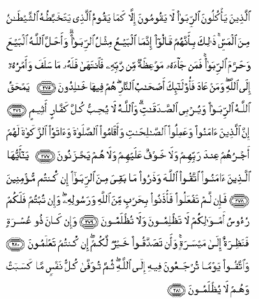
"Those who take interest
will not stand but as stands whom the demon has driven crazy by his touch. That
is because they have said: 'Trading is but like riba'.
And Allah has permitted trading and prohibited riba.
So, whoever receives an advice from his Lord and stops, he is allowed what has
passed, and his matter is up to Allah. And the ones who revert back, those are
the people of Fire. There they remain for ever. Allah
destroys riba and nourishes charities. And Allah does
not like any sinful disbeliever. Surely those who believe and do good deeds,
establish Salah and pay Zakah, have 11 their reward
with their Lord, and there is no fear for them, nor shall they grieve. O those
who believe, fear Allah and give up what still remains of the riba if you are believers. But if you do not, then listen
to the declaration of war from Allah and His Messenger. And if you repent,
yours is your principal. Neither you wrong, nor be wronged. And if there be one
in misery, then deferment till ease. And that you leave it as alms is far
better for you, if you really know. And be fearful of a day when you shall be
returned to Allah, then everybody shall be paid, in full, what he has earned.
And they shall not be wronged." [Surah Al-Baqarah
2:275-281]
What
is Riba?
The word "Riba" means excess, increase, or addition, which correctly
interpreted according to Shariah terminology, implies
any excess compensation without due consideration (consideration does not
include the time value of money). This definition of Riba
is derived from the Quran and is unanimously accepted by all Islamic scholars.
What
is meant by Shariah/Islamic Law?
Shariah lexically means a way or
path. In Islam, Shariah refers to the divine guidance
and laws given by the Holy Quran, the Hadith (sayings) of the Prophet Muhammad
(Peace Be Upon Him), and supplemented by the juristic interpretations by
Islamic scholars. Shariah embodies all aspects of the
Islamic faith, including beliefs and practices.
How do
Islamic banks generate profit to pay to their customers?
The Islamic bank uses its
funds in various trade, investment and service related Shariah
compliant activities and earns profit thereupon. The profit earned from such
activities is passed on to the depositors according to the agreed terms.
The
end result of Islamic Banking and Conventional Banking is the same/ Why do they
appear similar?
The validity of a
transaction does not depend on the end result but rather the process and
activities executed and the sequence thereof in reaching the end. If a
transaction is done according to the rules of Islamic Shariah
it is halal even if the end result of the product may look similar to
conventional banking product.
For example, a normal
burger in the Ghana and the Gambia may look similar, smell similar and taste
similar but the former is haram and the later is
halal due to its compliance of Islamic guidelines of slaughtering animals.
Similarly, if a person is
feeling hungry, he may steal a piece of bread and eat or alternatively buy a
piece of bread to eat. The apparent end result would be same but one is
permissible in Shariah and the other is not allowed.
The same is also true for
Islamic and conventional banking. Therefore, it can be concluded that it
is the underlying transaction that makes something "Halal" (allowed) or "Haram"
(prohibited) and not the result itsel Apparently,
Islamic banks may look similar to conventional banks, however the contracts and
product structures used by Islamic banks are quite different from that of the
conventional bank. In the verse 2:275 of the Holy Quran, Allah the Almighty has
responded to the apparent similarity between trade and interest by resolutely
informing that he has permitted trade and prohibited Riba
(though they may look similar to someone).
Is
Islamic banking meant only for Muslims?
The teachings of Islam are
not confined to Muslims, rather these equally address the non-Muslims due to
their universal nature. The basis of Islamic banks is laid down on ethical
values and socially responsible system. The values like justice, mutual help,
free consent and honesty on the part of the parties to a contract, avoiding
fraud, misrepresentation and misstatement of facts and negation of injustice or
exploitation form the basic principles of Islamic banking. Therefore, the
principles of Islamic banking lead the economic system to achieve the common
good and economic prosperity. On this premise, Islamic banking becomes a viable
option for everyone irrespective of their religion.